Skip to content

VgridPandas

VgridPandas - Integrates Vgrid DGGS with GeoPandas and Pandas, inspired by H3-Pandas.

VgridPandas supports a wide range of popular DGGSs, including H3, S2, A5, rHEALPix, DGGAL, DGGRID, Open-EAGGR ISEA4T, ISEA3H, EASE-DGGS, and QTM, OLC, Geohash, GEOREF, MGRS, TileCode, Quadkey, Maidenhead, and GARS.

logo

image image image image PyPI version image image

Full VgridPandas DGGS documentation is available at vgridpandas document

To work with Vgrid in Python or CLI, use vgrid package. Full Vgrid DGGS documentation is available at vgrid document

To work with Vgrid DGGS in QGIS, install the Vgrid Plugin.

To visualize DGGS in Maplibre GL JS, try the vgrid-maplibre library.

For an interactive demo, visit the Vgrid Homepage.

Installation

pip

image

1
pip install vgridpandas --upgrade

Key Features

  • Latlon to DGGS: Convert latitude and longitude coordinates into DGGS cell IDs.
  • DGGS to geo boundary: Convert DGGS cell IDs into their corresponding geographic boundaries.
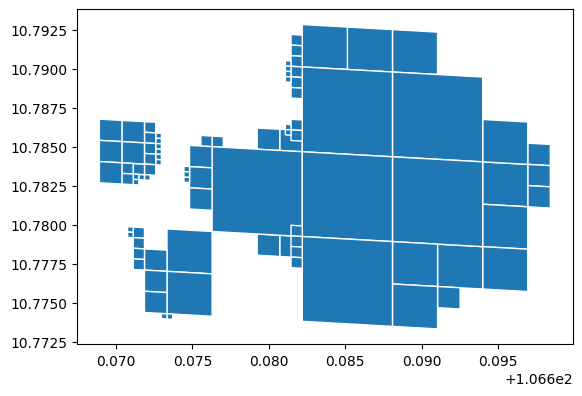
  • (Multi)Linestring/ (Multi)Polygon to DGGS: Convert (Multi)Linestring/ (Multi)Polygon to DGGS, supporting compact option.
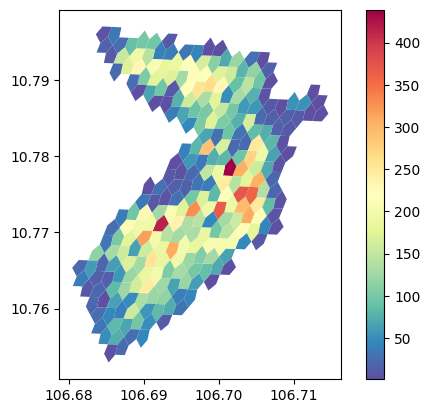
  • DGGS binning: Aggregate points into DGGS cells, supporting common statistics (count, min, max, etc.) and category-based groups.

Usage examples

Latlon to DGGS

 1
 2
 3
 4
 5
 6
 7
 8
 9
10
11
import pandas as pd
from vgridpandas import h3pandas
df = pd.DataFrame({'lat': [10, 11], 'lon': [106, 107]})
resolution = 10
df = df.h3.latlon2h3(resolution)
df

| h3              |   lat |   lon |
|-----------------|-------|-------|
| 8a65a212199ffff |    10 |   106 |
| 8a65b0b68237fff |    11 |   107 |

DGGS to geo boundary

1
2
3
4
5
6
7
df = df.h3.h32geo()
df

| h3              |   lat |   lon | geometry        |
|-----------------|-------|-------|-----------------|
| 8a65a212199ffff |    10 |   106 | POLYGON ((...)) |
| 8a65b0b68237fff |    11 |   107 | POLYGON ((...)) |

(Multi)Linestring/ (Multi)Polygon to DGGS

1
2
3
4
5
6
7
8
9
import geopandas as gpd
from vgridpandas import s2pandas

gdf = gpd.read_file('https://raw.githubusercontent.com/opengeoshub/vopendata/refs/heads/main/shape/polygon.geojson')
resolution = 18
gdf_polyfill = gdf.s2.polyfill(resolution, compact = True, predicate = "largest_overlap")
gdf_polyfill.head()
gdf_polyfill = gdf_polyfill.s2.s22geo("s2")
gdf_polyfill.plot(edgecolor = "white")

DGGS Binning

 1
 2
 3
 4
 5
 6
 7
 8
 9
10
11
12
13
14
15
16
17
18
import pandas as pd

resolution = 4
df = pd.read_csv('https://raw.githubusercontent.com/opengeoshub/vopendata/main/csv/dist1_pois.csv')
stats = 'count'
df_bin = df.a5.a5bin(resolution=resolution,
                    lat_col='lat',
                    lon_col='lon',
                    stats=stats,
                    # numeric_col=numeric_col,
                    # category_col= category_col,
                    )
df_bin.plot(
    column=f'{numeric_col}_{stats}',
    cmap='Spectral_r',
    legend=True,
    linewidth=0.2,
)

Further examples

For more examples, see the example notebooks.